When 3D printing is discussed, the conversation often gravitates towards efficiency, automation, and advanced industrial applications. Additive manufacturing is framed as a disruptive force—one that replaces old processes with new, digital ones.
Yet in Scotland, some of the most interesting and meaningful uses of 3D printing follow a very different logic. Additive manufacturing is increasingly used not to replace tradition, but to sustain it. It acts as an enabling layer—quietly supporting traditional professions, local production, and regional resilience, especially in places where skills, heritage, and livelihoods are deeply intertwined.
Harris Tweed: A Modern Tool for an ancient craft
Harris Tweed is often cited as a symbol of Scottish craftsmanship. Protected by law, the fabric must be woven by hand in the Outer Hebrides using traditional looms. This strict definition preserves authenticity—but it also creates practical challenges.
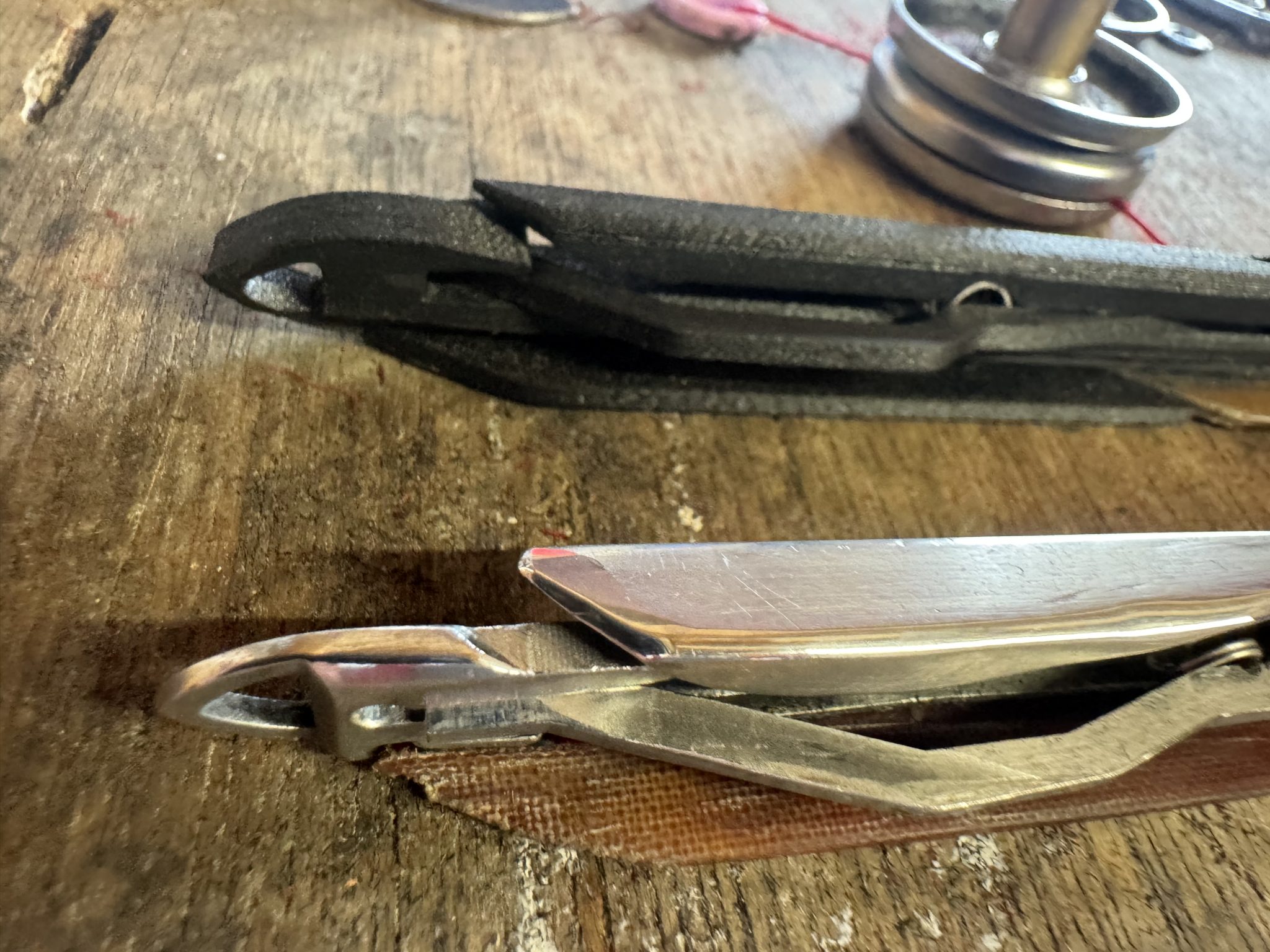
Old and new assemblies side by side. Photo via Harris Tweed. Source: https://3dprintingindustry.com/news/harris-tweed-integrates-3d-printing-into-traditional-weaving-with-nmis-collaboration-240108/
Many of the looms still in use are decades old. Spare parts are scarce, original manufacturers no longer exist, and importing custom components to remote islands is slow and expensive. Without intervention, these constraints could have quietly undermined the entire ecosystem.
This is where 3D printing enters the picture.
By redesigning and locally manufacturing replacement parts for historical looms, additive manufacturing has enabled:
- continued use of traditional equipment,
- dramatically lower maintenance costs, and
- faster repairs without reliance on external suppliers.
The weaving itself remains unchanged. The skills remain local. The difference is that the infrastructure supporting the tradition has become more resilient. Rather than disrupting the craft, 3D printing helps ensure that it can continue on its own terms.
Musical instrument making: Experimentation without waste
Scottish musical traditions offer another revealing example. Bagpipes and other traditional wind instruments rely on complex internal geometries that strongly influence sound, airflow, and playability. Prototyping these forms directly in wood is time-consuming, expensive, and unforgiving.
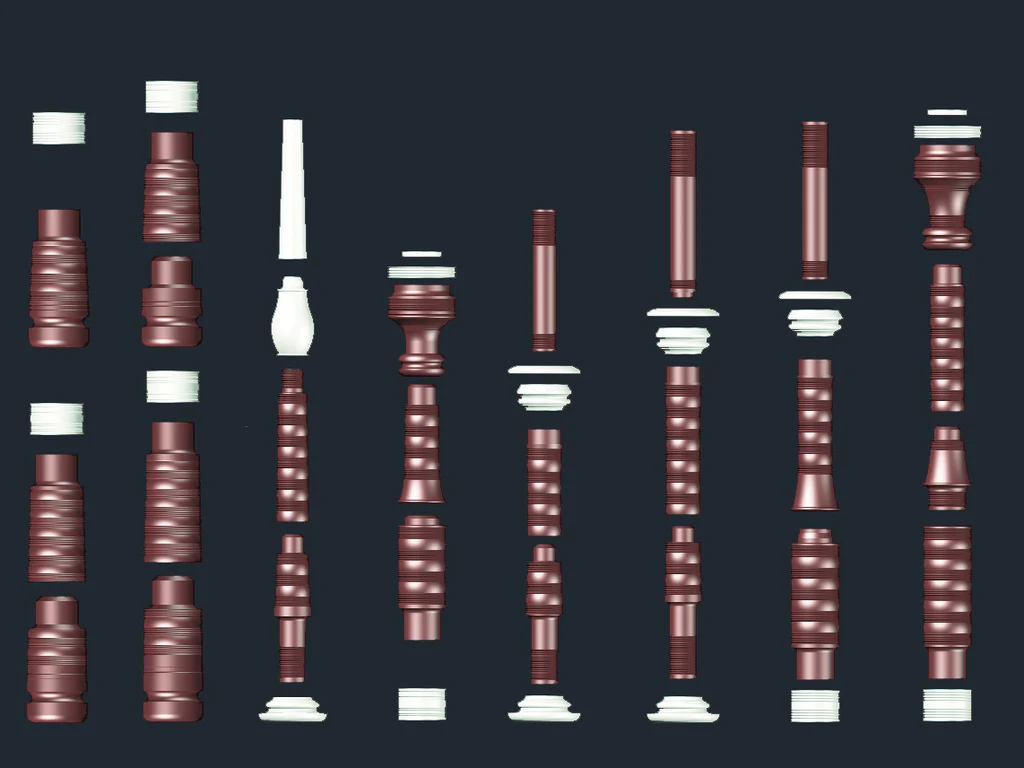
3D printed bagpipe components. Photo: Lindstruments. Source: https://lindstruments.com/products/3ddrones-a-printable-highland-bagpipe-drone-set-in-stl-form
In response, instrument makers, hobbyists, and researchers, often in collaboration with institutions such as the University of Strathclyde, use 3D printing to explore acoustic geometries before committing to final materials.
Applications include:
- prototyping practice chanter components,
- testing mouthpieces, joints, and internal channels, and
- reconstructing historical or rare instrument designs.
Importantly, 3D printing does not replace craftsmanship here. Finished instruments are still hand-made and hand-finished. Instead, additive manufacturing lowers the threshold for experimentation, reduces material waste, and makes traditional instrument making more accessible to new generations.
As with Harris Tweed, the tradition remains intact. The tools around it evolve.
Boatbuilding and maritime work: Keeping working boats working
Along Scotland’s west coast and island communities, small boatyards and fishing vessels remain economically vital. Many of these boats depend on parts that are no longer commercially available, or were never standardised to begin with.
In this context, 3D printing has been adopted in a pragmatic, almost understated way:
- obsolete plastic and metal components are replaced,
- rare parts are redesigned when original suppliers have disappeared, and
- custom tools and jigs are produced directly in repair yards.
In regions such as the Clyde and the Hebrides, this aligns naturally with a “working boats” mindset. Boats are not heritage artefacts frozen in time. They are tools that must remain operational, safe, and adaptable.
Local, on-demand manufacturing strengthens self-sufficiency, especially in remote areas where delays, shipping costs, or dependency on external suppliers can threaten livelihoods.
Cultural heritage and museums: Access without degradation
Scotland’s museums and universities embrace 3D scanning and printing, particularly in the field of cultural heritage and conservation.
Typical applications are:
- reconstructing fragmented archaeological artefacts,
- producing tactile replicas for inclusive and educational exhibitions, and
- reducing handling of fragile originals.
Institutions such as National Museums Scotland, alongside regional museums, use additive manufacturing to balance access and preservation. Cultural heritage can be shared, studied, and experienced, without consuming or damaging the original objects.
Here, 3D printing supports education, accessibility, and local identity, rather than spectacle or novelty.
A Different model of additive manufacturing adoption
Taken together, these examples reveal a distinct pattern. In Scotland, 3D printing is not primarily about scale, speed, or industrial optimisation. It is about continuity.
Additive manufacturing becomes:
- a tool for adapting traditions rather than abandoning them,
- a way to keep production local rather than offshored, and
- a means of strengthening regional resilience instead of centralising power.
This is a quieter narrative than the usual hype around 3D printing. But it may be one of the most important ones, especially as regions across Europe and beyond grapple with the question of how to preserve skills, identity, and local value creation in a digital world.
Pekka Ketola, Jan 10, 2026
 3d printing renaissance