3D Printing in Defence: From Experiment to Military Infrastructure

There is a recurring pattern in the history of manufacturing technologies. A new capability emerges, attracts enthusiasm, generates unrealistic expectations, disappoints and then quietly becomes foundational. We stop talking about it because it simply works.

Additive manufacturing in defence is somewhere in that middle phase, still loud enough to generate headlines, but increasingly real enough to reshape how militaries think about logistics, readiness, and operational continuity.

This article attempts to look past the noise. What is actually happening? Where does 3D printing genuinely matter in a defence context? What are the real bottlenecks, not the technical ones, but the systemic ones that rarely make it into press releases? And what does this mean for Europe, for NATO, and for a country like Finland?

The Strategic Shift: It Was Never Really About the Printer

The most important insight in the current wave of military additive manufacturing is deceptively simple: the printer is not the point.

What the US Navy, the British Army, and the European Defence Agency are quietly converging on is the same conclusion: the strategic asset is not a machine, but a certified digital manufacturing chain. That means approved digital design files, qualified materials, verified process parameters, traceable quality assurance, managed intellectual property rights, cybersecurity, trained personnel, and interoperability with alliance partners.

Without that chain, a 3D printer in a forward operating base is a workshop tool. With it, that same machine can become part of a nation’s defence readiness, force mobility, and operational resilience.

This reframing matters enormously. It shifts the conversation from procurement ”should we buy printers?” to infrastructure: ”how do we build a trusted, distributed, and interoperable digital production network?”

Why This Is Happening Now

Defence logistics has a structural problem that has been building for decades and was not caused by 3D printing. Large strategic stockpiles are expensive to maintain. Just-in-time supply chains, effective in peacetime, are brittle under the conditions of high-intensity conflict. And modern warfare consumes equipment, components, and unmanned systems at rates that traditional procurement pipelines were not designed to match.

The US Army’s own sustainment community has been explicit about this. Just-in-time logistics does not work in large-scale combat the way it works in peacetime supply chains. The implication is not comfortable: armed forces need the capability, the equipment, and the trained personnel to manufacture parts when and where the supply chain fails.

This is not a theoretical concern. Ukraine has demonstrated with uncomfortable clarity how quickly industrial assumptions collapse under sustained conflict. Dependency on single suppliers, long logistics tails, and centralised production capacity become vulnerabilities when those chains are disrupted.

Additive manufacturing offers three specific capabilities in this context.

The first is rapid parts availability, particularly for legacy systems whose original manufacturers no longer produce small batches, or have ceased operations entirely. Many defence platforms remain in service for decades. The industrial ecosystem that originally supported them does not always survive equally long.

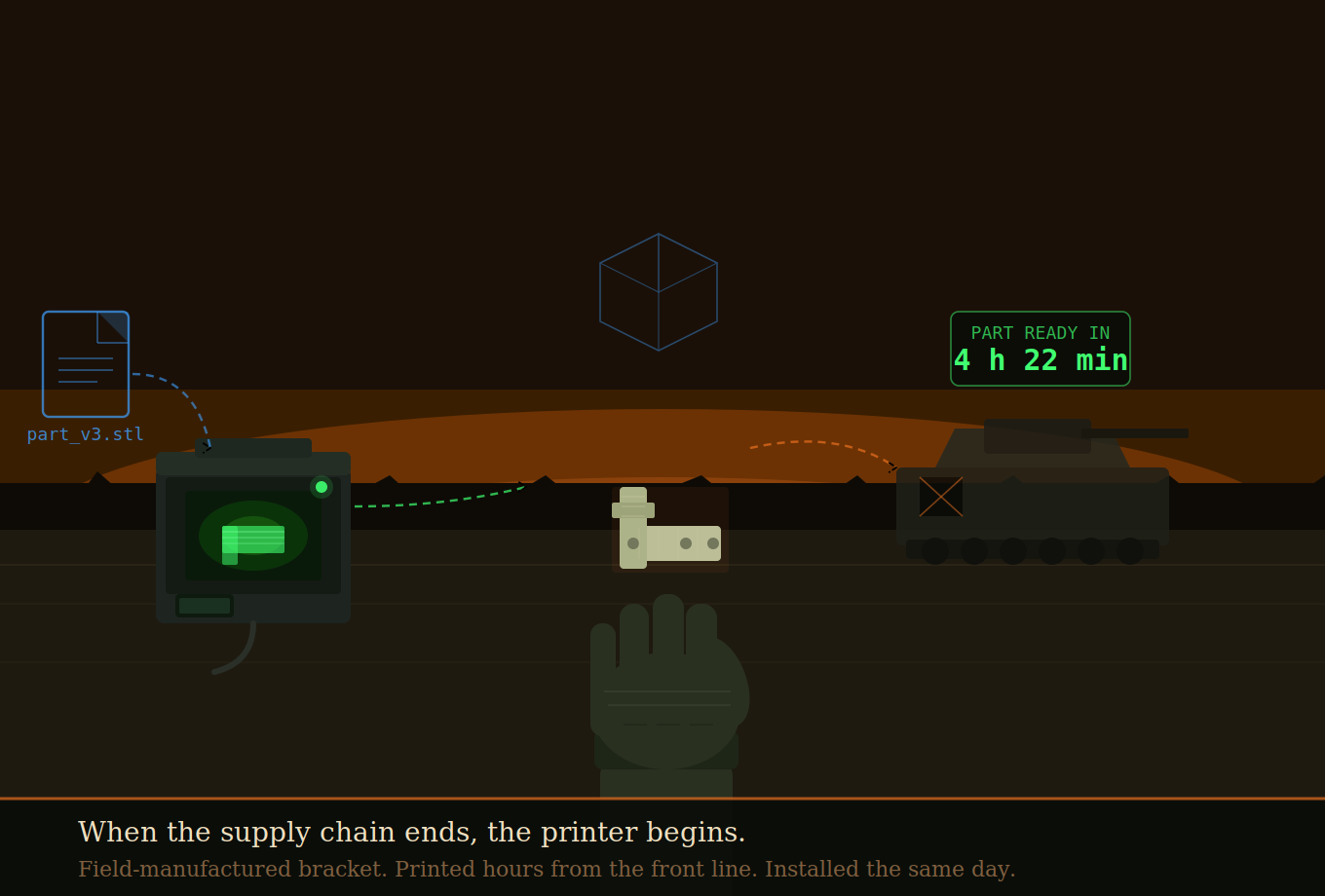
The second is forward or near-operation repair. A component can be manufactured or temporarily substituted close to where the equipment is operating, reducing the time a system spends out of service waiting for a part to travel through the logistics chain.

The third is fast iteration, especially relevant for drones, sensors, protective covers, mounting systems, and specialised tools. These categories have development cycles far shorter than traditional defence platforms, and additive manufacturing aligns well with that tempo.

The US Navy’s 2026 reporting captures the trajectory clearly. What was once ”promising technology” has become an established military capability, with documented reductions in component lead times of up to 70 percent, and metal 3D-printed parts qualified for use on nuclear-powered carriers and Virginia-class submarines. Naval aviation maintenance has delivered the first flight-worthy metallic additively manufactured parts to the fleet and is building approval pathways across multiple aircraft types.

What Europe Is Actually Doing?

In Europe, additive manufacturing in defence is now connected to four larger political and strategic themes: lessons from Ukraine, EU defence industrial readiness, NATO interoperability, and supply chain sovereignty.

The European Defence Agency held its AM Village 2026 event in Spain in March, described as one of the world’s largest workshops dedicated to additive manufacturing in defence. Around 800 specialists from 14 EU member states, plus Norway, the UK, and Ukraine, examined mobile solutions and components across vehicle, weapons system, and rocket motor categories. Both Finland and Sweden were among the participating nations — a signal that the topic is already embedded in Nordic defence cooperation at the European level.

EDA’s own position is consistent: the military value of additive manufacturing lies especially in the ability to produce parts closer to the point of need, reducing the logistics footprint and improving availability. The bottlenecks it identifies are instructive, not primarily technical, but systemic: intellectual property rights, training, standardisation, certification, and health and safety. Europe’s challenge is not whether to acquire printers. It is how to build an approved, secure, and interoperable digital production network.

The United Kingdom is one of Europe’s most visible leaders in this space. The Ministry of Defence published its first Defence Advanced Manufacturing Strategy in 2025, explicitly targeting shorter lead times, more flexible supply chains, and distributed manufacturing networks. Project TAMPA focuses precisely on the elements that define real additive manufacturing capability in defence: secure file transfer, IP rights, certification, parts approval, and inventory management. Project Brokkr frames the relationship between field manufacturing and the logistics chain with useful clarity, forward production does not replace the logistics chain; it reduces the pressure on it and accelerates repair.

Ukraine has compressed the timeline for all of this. The Ukrainian Ministry of Defence’s Library of Components initiative assembles domestic manufacturing services including additive manufacturing, deliberately reducing dependence on foreign supply chains. The practical lessons emerging from Ukraine, about drones, spare parts, field conditions, power availability, environmental constraints, and quality assurance, are already influencing how European armed forces think about distributed manufacturing.

The EU’s broader Readiness 2030 framework reinforces this direction. It emphasises drones and counter-drone systems, strategic enablers, industrial readiness, joint procurement, and strengthening the defence market. Additive manufacturing fits naturally into this logic, it improves responsiveness, reduces single-supplier dependency, and supports distributed production capacity.

EU-funded research projects are already operational in this space. DISCMAM is developing field-suitable metal additive manufacturing with secure digital chains, remote support, and process optimisation for spare parts production and repair. ROLIAC focuses on lightweight, durable components and new materials suited to military application.

NATO and the Interoperability Imperative

From NATO’s perspective, the defining challenge for additive manufacturing is interoperability. If one member nation prints a spare part and another nation’s forces need to rely on it, trust requires verification. If a technical data package is shared across alliance partners, its origin, version, materials, process parameters, and approval status must all be traceable and mutually recognised.

NATO’s updated Defence Production Action Plan from 2025 emphasises exactly these themes: growing industrial capacity, standardisation, interoperability, production capacity visibility, faster technology adoption, and inclusion of startups and SMEs in the defence industrial base.

NATO’s Science and Technology Organisation has previously identified the need for NATO-level material and process standards, a digital spare parts library, shared quality assurance frameworks, and common logistics infrastructure for additive manufacturing. More recent STO work, specifically the AVT-342 study, has focused on AM interoperability in NATO operations and how additive manufacturing can be integrated with logistic support structures.

The message for Europe and for Finland is clear. Additive manufacturing in defence is not a national technology project. It is a question of NATO interoperability, defence industrial integration, and supply chain resilience at alliance scale.

Where the Real Value Lies

Five use cases concentrate the majority of genuine near-term value.

Legacy platform sustainment is the most immediate and least controversial. Many defence systems remain operational for thirty or forty years. The original supplier, tooling, and subcontractor ecosystem rarely survives equally long. The US Air Force uses additive manufacturing explicitly for supply chain and obsolescence problems across multiple aircraft types, cases where there is no conventional manufacturing alternative at viable scale or cost.

Rapid repair and temporary substitution can be transformative at the operational level. The US Army’s Battle-Damaged Repair and Fabrication initiative produced temporary replacement parts within hours or days and delivered them in under a week. Some tested solutions exceeded the material strength of original components. Speed and proximity matter more than perfection when a system is out of service.

Drones and rapidly evolving systems represent perhaps the most visible current application. Ukraine and the UK both demonstrate that additive manufacturing supports fast-cycle drone development, training, spare parts production, and field experimentation. The development tempo of unmanned systems is far shorter than traditional platforms, months, not decades, and additive manufacturing is well matched to that pace.

Tools, fixtures, protective covers, adapters, and training aids are unglamorous but operationally important. These items are often produced in very small quantities, are highly specific to particular equipment configurations, and their unavailability can constrain daily operational capability. US Army units already use 3D printing for radio covers, equipment modifications, training props, and decoys.

Field structures and protective infrastructure represent an emerging frontier. EDA is examining 3D-printed T-wall protective barriers as an alternative to heavy infrastructure that must be transported over long distances. The goal is not simply cost reduction, it is the ability to build protection and operational structures more locally and more flexibly.

The Bottlenecks That Matter

Most public discourse about additive manufacturing focuses on technical progress, better materials, faster machines, larger build volumes. These matter. But they are not where the real constraints lie for military adoption.

Certification is the first and most fundamental barrier. A component for an aircraft, armoured vehicle, or naval vessel cannot be ”close enough.” Materials, manufacturing processes, post-processing, testing, and traceability must all meet approved standards. This process is slow by design because the consequences of failure are not acceptable.

Data rights and intellectual property are the second barrier, and arguably the most underappreciated. Armed forces cannot print a part if they do not have the legal right to access, use, modify, or transfer the technical data package. The UK’s Project TAMPA identifies this as one of the central problem areas. It affects not just which parts can be manufactured, but whether a digital manufacturing ecosystem can be built at all. Future defence procurement contracts will need to define from the outset which parts can be manufactured distributedly, under what conditions, and through what approval chain.

Cybersecurity is the third barrier, and it connects to both of the above. A digital spare parts library is simultaneously a critical infrastructure asset. If design files are manipulated, subtly, undetectably, the result can be invisible material failure in a safety-critical component. A secure digital chain is at least as important as the manufacturing hardware itself.

Skills and workforce are the fourth barrier. Field conditions require soldiers, engineers, maintenance personnel, and industrial partners who understand both manufacturing processes and operational safety. The US Army is explicit: equipment alone is insufficient. Trained personnel must accompany the capability.

Doctrine and procurement are the fifth barrier and the one with the longest leverage. If defence organisations continue to acquire systems without digital repair rights, without technical data packages, and without additive-manufacturing-ready design specifications, 3D printing will remain an isolated experiment regardless of how capable the technology becomes. The shift must happen upstream, in how requirements are written and how contracts are structured.

What This Means for Finland

For Finland, additive manufacturing in defence is fundamentally a supply chain resilience and NATO interoperability question. These are not abstract strategic categories, they connect directly to Finland’s defence philosophy, geographic position, and industrial strengths.

Finland’s advantages in this context are real. Strong technical competence, a capable machine tool and materials industry, a dense ecosystem of engineering SMEs, advanced digital design capabilities, and a practical defence culture that values operational self-sufficiency. The presence of Finland and Sweden in EDA’s AM Village 2026 suggests that Nordic participation in European defence manufacturing cooperation is already happening.

The relevant questions for Finland are not about whether 3D printing will be used to manufacture primary weapons systems. They are more specific and more tractable. How can spare parts, repair solutions, tools, sensor housings, protective covers, drone components, training equipment, and field infrastructure elements be produced, approved, and deployed in ways that reduce dependency on distant supply chains and increase operational continuity?

These are precisely the use cases where additive manufacturing can add genuine military value without attempting to substitute for the serial production of complex defence systems. The capability is not a replacement for a defence industrial base. It is a complement to it filling the gaps that mass production leaves, and maintaining readiness when the supply chain cannot.

The Longer Arc

Looking further ahead, the trajectory of additive manufacturing in defence converges on something larger than any single technology. It points toward a fundamental rethinking of where production capacity should reside, not concentrated in a small number of large facilities at the end of long supply chains, but distributed closer to the point of operational need, supported by certified digital infrastructure that can be trusted across alliance boundaries.

This is not a radical vision. It is a practical response to lessons that high-intensity conflict has already provided. The question is not whether additive manufacturing will be part of defence logistics and readiness in the coming decades. It will be. The question is whether the institutional, regulatory, and doctrinal infrastructure required to use it effectively will be built before or after the next crisis makes its absence painfully obvious.

The printer is not the point. The infrastructure around it is.

3D-tulostus ja soittimet

3D-tulostus on tehnyt merkittävän läpimurron musiikki-instrumenttien valmistuksessa. Perinteisesti soittimet on valmistettu puusta, metallista tai muista luonnonmateriaaleista. Nykyään on mahdollista luoda toimivia ja laadukkaita soittimia suoraan 3D-tulostimella.

Esimerkiksi 3DVarius, maailman ensimmäinen 3D-tulostettu sähköviulu, on saanut paljon huomiota. Se perustuu klassiseen Stradivariuksen muotoon, mutta on valmistettu yhdestä kappaleesta tulostetusta materiaalista, mikä tekee siitä kevyen ja kestävän. Myös metallisten kitarakomponenttien valmistus on kokenut muutoksen: APG Group on kehittänyt palkittuja 3D-tulostettuja metallikomponentteja kitaroihin, parantaen niiden kestävyyttä ja akustisia ominaisuuksia.

Kuva: 3DVarius. Kuva © Thomas Tetu. Artikkeli: Stringsmagazine

Miksi?

3D-tulostuksen tuominen soitinvalmistukseen tuo mukanaan monia etuja:

  • Räätälöinti – Soittimet voidaan muokata soittajan kädenjälkeen ja ergonomisiin tarpeisiin sopiviksi.
  • Kevyempi rakenne – Tulostetut osat voivat olla perinteisiä kevyempiä menettämättä akustisia ominaisuuksiaan.
  • Kustannustehokkuus – Erityisesti prototyyppien valmistuksessa 3D-tulostus säästää aikaa ja materiaaleja.
  • Kestävyys ja innovaatio – Uudet materiaalit ja tulostustekniikat voivat parantaa soitinten äänenlaatua ja kestävyyttä.

Miten?

3D-tulostus toimii eri tavoin riippuen soittimesta ja sen osista. Esimerkiksi kitaroiden osia voidaan valmistaa metallin jauhepetisulatusmenetelmällä (SLM), jolloin saadaan aikaan kevyitä mutta kestäviä komponentteja. Toisaalta 3DVarius-viulu hyödyntää kestävää akryylimateriaalia ja SLA-tulostusta (stereolitografia), mikä mahdollistaa saumattoman ja resonanssiltaan erinomaisen rakenteen.

Tulevaisuuden instrumentit ja tekoälyn rooli

Tulevaisuudessa akustiset soittimet, 3D-tulostus ja tekoäly voivat yhdistyä luoden uusia ääniä ja instrumentteja, joita ei ole ennen kuultu. Tekoäly voi generoida uusia ääniä, kuten valaan ja pianon äänen yhdistelmän, ja mallintaa, millainen akustinen rakenne ja materiaali tuottaa juuri tämän soinnin. Nämä akustiset rakenteet voidaan sitten 3D-tulostaa, jolloin syntyy täysin uusia instrumentteja, orkestereita ja sävellyksiä.

Uusia soittimia voidaan kehittää ja personoida laajasti, mikä mahdollistaa entistäkin rikkaamman äänimaailman. Tulevaisuudessa voimme nähdä instrumentteja, jotka mukautuvat soittajan tyyliin ja tuottavat ainutlaatuisia ääniä, joista nykyiset soittimet eivät kykene vastaamaan.

Kuva: Tekoälyn kuvittelema tulevaisuuden soitin

Johtopäätöksiä

3D-tulostus on tuonut musiikki-instrumenttien maailmaan uuden aikakauden, jossa räätälöidyt, kevyemmät ja innovatiivisemmat soittimet tulevat mahdollisiksi. Teknologian kehitys tarkoittaa, että tulevaisuudessa voimme nähdä entistä parempia ja monipuolisempia soittimia, jotka ovat sekä saavutettavia että korkealaatuisia.

3D-tulostetut ja tekoälyllä suunnitellut soittimet eivät ole enää tulevaisuuden visio, vaan jo todellisuutta. Voisiko seuraava soittimesi olla 3D-tulostettu ja tekoälyn generoima?

Sovelluksia ja esimerkkejä

1. Instrumenttien valmistus

  • Koko instrumentin tulostaminen: Esimerkiksi saksofoneja, viuluja ja ukuleleja on valmistettu kokonaan 3D-tulostimella. Muovista tulostetut soittimet ovat kevyempiä ja edullisempia kuin perinteiset.
  • Komponenttien valmistus: Tulostusta käytetään yksittäisten osien, kuten huilun suukappaleiden tai kitaran satuloiden ja tallojen, valmistukseen.

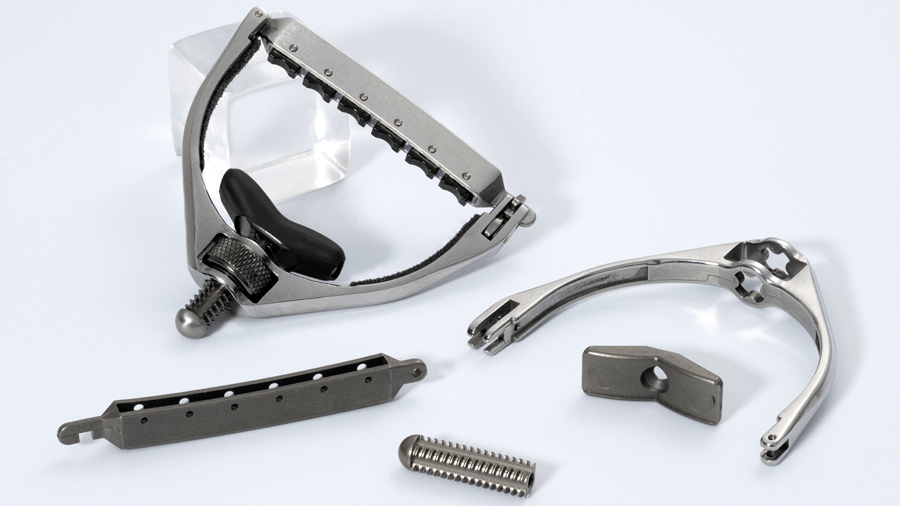
Six-string guitar capo assembly, produced via MIM and AM by APG-MIM (Courtesy MPIF)

Lähde: https://www.metal-am.com/apg-to-showcase-use-of-additive-manufacturing-in-the-creation-of-award-winning-mim-guitar-components-at-mim2025/

2. Mukautetut ja räätälöidyt ratkaisut

  • 3D-tulostus mahdollistaa soittimien mukauttamisen soittajan tarpeiden mukaan, esimerkiksi ergonomisesti suunniteltuja käyrätorvia tai yksilöllisiä sähkökitara-bodyja.
  • Se mahdollistaa myös nopeasti prototyyppien luomisen uusista instrumenttimalleista.

3. Korjaus ja varaosat

  • Harvinaisten tai vanhojen soittimien varaosia voidaan tulostaa silloin, kun alkuperäisiä ei enää valmisteta.
  • Esimerkiksi pianon vasaroita tai saksofonin näppäimiä voidaan valmistaa tulostamalla, jolloin soitin voidaan palauttaa soittokuntoon edullisesti.

4. Akustiikan ja suunnittelun tutkimus

  • 3D-tulostus mahdollistaa erilaisten materiaalien ja muotojen kokeilun akustiikan parantamiseksi. Esimerkiksi erikoisvalmisteiset viulun kopat voivat muuttaa soinnin ominaisuuksia.
  • Tulostettujen rakenteiden avulla voidaan luoda uusia äänimaailmoja, joita perinteisillä materiaaleilla ei helposti saavuteta.

5. Soittimien saavutettavuus

  • 3D-tulostus voi tehdä soittimista edullisempia ja helpommin saatavilla olevia, erityisesti oppilaitoksille ja musiikin harrastajille.
  • Esteettömyyttä voidaan parantaa suunnittelemalla soittimia erityistarpeisiin, esimerkiksi vammaisten muusikoiden käyttöön.

Esimerkkejä 3D-tulostetuista instrumenteista

  • Hovalin-viulu: Täysin 3D-tulostettu sähköviulu, kevyt ja muokattava. Avoin lähdekoodi.
  • 3D-tulostetut huilut ja klarinetit: Testattu klassisessa musiikissa ja opetuskäytössä.
  • MONAD: Kustomoitu, futuristinen 3D-tulostettu kitara.
  • Olaf Diegel, 3D-tulostetut kitarat

3D-tulostus ja science fiction: Teknologian inspiroijat ja ennustajat

Science fiction on toiminut alustana, jossa 3D-tulostuksen kaltaiset teknologiat on kuvattu jo kauan ennen niiden toteutumista. Nämä tarinat ovat paitsi inspiroineet teknologista kehitystä, myös valmistaneet yleisöä uusien innovaatioiden eettisiin ja yhteiskunnallisiin vaikutuksiin. Esimerkiksi Star Trek -sarjassa esiintynyt ”replikaattori” muistuttaa hämmästyttävän paljon nykyaikaisia 3D-tulostimia. Sarjan laite kykeni tuottamaan lähes mitä tahansa materiaalia, ja se on sittemmin inspiroinut tutkijoita kehittämään teknologioita, jotka voivat valmistaa monimutkaisia esineitä kerros kerrokselta.

3D printing in science fiction

Kirjallisuus

Science fiction -kirjallisuudessa 3D-tulostus on ollut pitkään merkittävässä roolissa ennakoimassa ja inspiroimassa teknologian kehitystä. Kirjailijat kuten Hannu Rajaniemi ovat hyödyntäneet teknologian potentiaalia luodessaan maailmoja, joissa nanoteknologia ja materiaalien muokkaus ovat arkipäivää.

Rajaniemen Kvanttivaras-sarjassa materiaalien hallinta ulottuu molekyylitasolle, tarjoten lukijalle vision siitä, kuinka 3D-tulostus voisi tulevaisuudessa muuttaa sekä tuotantoa että yhteiskuntaa. Aiemmin William F. Temple esitteli idean bioprinttauksesta tarinassaan Four Sided Triangle, jossa ihminen rakennettiin molekyyli molekyyliltä. Tämä ennakoi nykypäivän keskustelua biotulostuksen mahdollisuuksista ja eettisistä kysymyksistä. Teoksesta on myös elokuva.

Neal Stephensonin The Diamond Age tutkii 3D-tulostuksen potentiaalia. Kirjassa nanoteknologia ja materiaalien ohjelmoitavuus mahdollistavat sellaisten esineiden ja tuotteiden valmistuksen, jotka mukautuvat käyttäjiensä tarpeisiin. Stephensonin visio tarjoaa näkemyksen siitä, kuinka 3D-tulostuksen ja nanoteknologian yhdistelmä voisi demokratisoida tuotantoa ja luoda uudenlaista taloudellista tasa-arvoa.

Science fiction -kirjallisuus on toiminut teknologian kehittäjien inspiraation lähteenä. Kuvaukset resursseja säästävistä tuotantomenetelmistä ja yksilöllisistä ratkaisuista heijastuvat todellisuuteen esimerkiksi muovituotteiden edullisessa piensarjavalmistuksessa. Science fiction auttaa pohtimaan teknologian vaikutuksia niin yhteiskunnallisesti kuin kulttuurisestikin.

Cory Doctorow’n Makers pureutuu 3D-tulostuksen vaikutuksiin yhteiskunnassa ja taloudessa. Doctorow käsittelee tarinassaan sitä, kuinka yksilölliset valmistusmenetelmät ja hajautetut tuotantojärjestelmät voivat muuttaa perinteisen teollisuuden ja kuluttajien roolit. Kirjassa innovatiiviset hahmot käyttävät 3D-tulostusta luodakseen uusia liiketoimintamalleja, jotka haastavat suuryritysten aseman.

Elokuvat ja televisiosarjat

Elokuvissa ja televisiosarjoissa 3D-tulostus on kuvattu monipuolisesti ja usein huikeasti tulevaisuuteen ulottuvana teknologiana. Star Trekin ”replikaattori” muistuttaa modernia 3D-tulostinta. Laite pystyi tuottamaan ruokaa, tarvikkeita ja jopa varaosia avaruusmatkailijoiden tarpeisiin, ennakoiden sekä materiaalin hallinnan että yksilöllisen valmistuksen kehittymistä. Samankaltaista ideaa jatkoi The Jetsons, jossa ”Food-a-Rac-a-Cycle” tuotti ruokaa nykyaikaisia ruokatulostimia muistuttaen.

Modernit tarinat, kuten Westworld-sarja, ovat vieneet idean pidemmälle, käyttäen kehittyneitä 3D-tulostimia ihmisten kaltaisten androidien luomiseen. Tämä käsittelee myös eettisiä ulottuvuuksia, joita liittyy kehittyvän teknologian käyttöön. Lääketieteellisessä draamassa Grey’s Anatomy esiteltiin 3D-tulostusta verisuonten valmistamiseen, mikä tuo teknologian mahdollisuudet konkreettisella tavalla katsojan arkeen.

Science fiction -tarinat toimivat paitsi ideoiden hautomona, myös väylänä valmistaa yleisöä teknologian eettisiin ja käytännön vaikutuksiin. Monia näistä sovelluksista, kuten verisuonten tulostamista tai räätälöityjä tuotteita, on jo siirretty laboratorioista käytännön sovellutuksiin, osoittaen kuinka media voi inspiroida todellisia tieteellisiä läpimurtoja.

Tarinat eivät pelkästään heijasta teknologian potentiaalia, vaan ne toimivat ideoiden hautomoina, joissa uusia teknologioita voidaan kuvitella, testata ja arvioida ennen niiden todellisuutta. Ne ovat valmistaneet yhteiskuntaa hyväksymään uusia innovaatioita ja inspiroineet tutkijoita toteuttamaan ideoita käytännössä.

On mielenkiintoista huomata, että monet science fiction -tarinoiden 3D-tulostukseen liittyvät visiot, kuten bioprinttaus ja materiaalin tehokas valmistus, ovat muuttumassa todellisuudeksi. Tämä korostaa sitä, kuinka tieteiskirjallisuus voi toimia merkittävänä ajattelun katalyyttina ja suunnannäyttäjänä tieteellisille ja teknologisille läpimurroille.

Kirjoja

  • Bear, Greg. Blood Music. Arbor House, 1985. Explores self-replicating biotechnologies, which resonate with the themes of advanced 3D bioprinting.
  • Clarke, Arthur C. Profiles of the Future: An Inquiry into the Limits of the Possible. Harper & Row, 1962. Discusses future technologies, including concepts resembling 3D manufacturing and its societal impact.
  • Doctorow, Cory. Makers. Tor Books, 2009. A novel about a near-future world where 3D printing and micro-manufacturing revolutionize industries and creativity.
  • Gibson, William. Count Zero. Arbor House, 1986.
    Features automated and decentralized production, highlighting early conceptualizations of additive manufacturing.
  • Gibson, William. The Peripheral. Berkley, 2014. Explores advanced technologies like ”fabricators,” resembling futuristic 3D printers, in a dystopian setting.
  • Lem, Stanisław. Return from the Stars. Harvest Books, 1961. Describes ”betryzing,” a form of futuristic manufacturing and replication technology similar to 3D printing.
  • Scalzi, John. The Collapsing Empire. Tor Books, 2017. Includes elements of advanced manufacturing in its depiction of a highly developed interstellar society.
  • Stephenson, Neal. The Diamond Age: Or, A Young Lady’s Illustrated Primer. Bantam Books, 1995.
    Features advanced molecular manufacturing, a speculative precursor to 3D printing technologies.
  • Temple, William F. Four Sided Triangle. Gnome Press, 1949. An early exploration of the concept of molecular duplication, akin to bioprinting, later adapted into a 1953 film.
  • Vinge, Vernor. Rainbows End. Tor Books, 2006.
    Set in a world where ubiquitous computing and advanced manufacturing, including 3D printing, have transformed society.

Tiedätkö muita tieteiskirjoja tai -elokuvia, joissa 3D-tulostus on mukana?

Pekka Ketola. 8.2.2025