3D printing in rocket manufacturing is entering a new phase in which it is becoming an integral part of a rapidly changing space industry. Only a few years ago, attention focused on whether a rocket engine or even an entire rocket could be manufactured using 3D printing. Today, the more interesting question is what new products, services and business models the technology can enable. At the same time, entirely new players have entered the market and begun challenging established space companies.
In July 2026, Indian company Skyroot Aerospace reached a significant milestone when its Vikram-1 launch vehicle carried two satellites into orbit. It was the first successful orbital launch conducted from India by a private Indian company. Remarkably, the mission succeeded on its first attempt. (3D Printing Industry)
Vikram-1 was a four-stage launch vehicle. Its first three stages used solid propellant and conventional manufacturing methods. The fourth, or upper, stage was powered by the liquid-fuelled Raman-1 engine, whose key structures were manufactured using 3D printing. The engine could be restarted in space, allowing the upper stage to fine-tune the trajectory and place the satellites into their planned orbit. (ISRO)
Skyroot’s launch is part of a broader transformation taking place in the rocket industry. Only a few years ago, a 3D-printed rocket engine was primarily a technology demonstrator. Today, printed engines are used in commercial launch vehicles, satellite orbital-transfer stages, crew escape systems and rockets designed for reuse.
The companies leading this development are not limited to those building complete launch vehicles. The industry now includes independent engine suppliers, manufacturers of in-orbit transportation systems and companies offering rapidly configurable launch and propulsion solutions. At the same time, public space organisations such as India’s ISRO, the European Space Agency (ESA) and NASA are developing testing, launch and procurement environments for new commercial players.
It is therefore no longer useful to view rocket 3D printing merely as a new way to manufacture complex metal components. The more important question is what kinds of new services, companies and operating models for space transportation are emerging around the manufacturing method.
A satellite customer does not buy a printed engine. The customer buys access to a specific orbit, on a specific launch date, with the lowest possible risk. A restartable upper stage can finalise the trajectory, adjust the timing and place the payload closer to its actual operational destination. In the future, the same stage may transport satellites from a single launch to several different orbits. The upper stage of a launch vehicle is beginning to resemble a transportation vehicle for space logistics.
Growth in Small Satellites Does Not Guarantee the Success of Small Rockets
The small satellite market appears enormous. In 2024, 2,790 satellites weighing no more than 1,2 kilograms were launched. They represented 97 per cent of all spacecraft launched that year. However, only six per cent were launched on small or micro launch vehicles. Most travelled as secondary payloads aboard larger rockets. (BryceTech: Smallsats by the Numbers 2025)
The reason is simple. A large rocket can distribute its costs among dozens of customers. SpaceX currently offers a 50-kilogram payload slot to a sun-synchronous orbit at a starting price of USD 350,000. It is extremely difficult for a small launch vehicle to undercut that price per kilogram. (SpaceX Rideshare Program)
The competitive advantage of a small rocket may therefore not be price. It may instead be speed, a dedicated launch window, a preferred orbital plane, confidentiality or independence from another customer’s schedule. This is also at the heart of Skyroot’s commercial proposition. The company describes its service as fast, precise and customised access to orbit. (Skyroot Aerospace)
Rocket Lab’s More Mature Operating Model
Rocket Lab has so far provided the clearest benchmark for the use of 3D printing in rocket manufacturing. The key components of the Rutherford engines used in its Electron rocket are produced using 3D printing. As early as 2019, the company stated that major engine components could be printed within 24 hours. By 2023, a total of 350 Rutherford engines had been sent into space. (Rocket Lab)
The decisive word here is not “printed,” but “350.” A single printed engine demonstrates that something is possible. Hundreds of flown engines begin to demonstrate process repeatability, quality management, testing capability and production control.
In June 2026, Rocket Lab carried out the VICTUS HAZE mission for the United States Space Force only 16 hours and 42 minutes after receiving the final launch order. In addition to the rocket, the company supplied the satellite and managed its orbital operations. (Rocket Lab’s VICTUS HAZE mission)
This was not achieved by printing a rocket overnight. The hardware, organisation and launch site were already prepared. 3D printing was one element within a system designed for rapid response.
Relativity Demonstrated That Not Everything Should Be Printed
Relativity Space became known for its ambition to print almost an entire rocket. Its Terran 1 flew in 2023 and successfully passed through the point of maximum aerodynamic stress, but it failed to reach orbit because of a second-stage problem. The company subsequently discontinued the Terran 1 programme and shifted its focus to the much larger Terran R rocket. (RocketSTEM)
Terran R still makes extensive use of 3D printing, but the company no longer aims to print everything. Straight aluminium tank sections are manufactured using a hybrid approach based on conventional manufacturing methods. Printing is focused on engines, interfaces and structures where it can reduce the number of parts or simplify manufacturing. (Relativity Space)
This change is a sign of industrial maturity. Once a technology moves beyond the demonstration phase, it no longer needs to be visible everywhere. It needs to be used where it improves the overall system. The same pattern has been seen in many other industries. A new method is initially used to demonstrate how much can be achieved with it. Later, the industry learns where it is most valuable.
The Engine Can Become a Product and a Supply Chain
Ursa Major represents a new category of company in the rocket industry. Rather than primarily building its own launch vehicle, it supplies engines for other companies’ vehicles.
Its Hadley H13 is intended for a range of light-launch and hypersonic applications. According to Ursa Major, approximately 80 per cent of the engine is manufactured using 3D printing. More important, however, is the company’s ambition to turn it into an off-the-shelf product that does not require every customer to spend years developing an engine of its own. (Ursa Major)
This could change the structure of the entire industry. A new launch company would no longer need to develop the rocket, engine, manufacturing process and testing infrastructure at the same time. It could buy part of the system as a ready-made product and concentrate on the area in which it has its own competitive advantage.
An engine supplier, in turn, can collect flight data from several customers’ missions. The more engines from the same product family that fly, the more valuable the qualification and reliability data become.
Financing the Space Industry
Skyroot’s success was not simply a startup story. The Indian Space Research Organisation, ISRO, provided testing facilities, a launch site, safety services and technical support. IN-SPACe helped the private company gain access to public infrastructure and navigate licensing and readiness processes. (ISRO)
Europe is building a similar model through the European Launcher Challenge. The European Space Agency is acting as a customer for new launch companies and has allocated more than EUR 900 million to the programme. The participating companies must demonstrate a successful orbital launch by 2027, after which ESA will support the introduction of their operational launch services. (European Space Agency: European Launcher Challenge)
This is an important reminder: a space industry cannot be created through venture capital alone. Initial flights are expensive, failures are common and reliability takes time to establish. The public sector does not necessarily need to design the rocket. Its more important role may be to act as the first customer and provide infrastructure that an individual company could not build on its own.
The Next Market Is in Orbit
As printed engines become smaller, some of their most interesting applications are gradually shifting away from the launch vehicle itself and towards spacecraft operating in orbit.
Agile Space Industries’ M4 engine is intended for applications including satellite approach, docking, inspection, refuelling and servicing. According to the company, the engine can be manufactured to order within eight weeks. (Agile Space Industries)
ESA has also tested a printed engine concept with potential applications in orbital-transfer stages, orbital transport vehicles, micro launchers, lunar landers and vehicles designed to ascend from the Moon. (European Space Agency)
The strengths of 3D printing align particularly well with these applications. Production volumes are small, every kilogram matters, missions vary and delivery times may be critical. A customer may need only a few engines, but they must be precisely suited to a particular spacecraft and mission.
Delivery Capability Matters More Than the Amount Printed
Public discussion about the rocket industry still often focuses on how much of a rocket has been 3D printed. It is a striking metric, but from a business perspective, it is not a particularly useful one.
More meaningful indicators include the time from design freeze to an approved flight unit, the proportion of components accepted on the first attempt, launch frequency, the number of successful flights, the cost of payload delivered to orbit and the ability to implement design changes in a controlled manner.
A printed component still requires machining, measurement, inspection and testing. In NASA’s RAMPT programme, printed engine structures had accumulated more than 16,000 seconds of hot-fire testing and nearly 500 starts. It is this kind of data that transforms a new manufacturing method into a reliable industrial process. (NASA: Rapid Analysis and Manufacturing Propulsion Technology)
Skyroot’s launch was therefore important, but it was not the endpoint of the industry’s development. It demonstrated that 3D printing can form part of a commercial orbital launch conducted in a new country by a new market entrant.
The next stage will be even more significant. Can Skyroot fly again? How soon? At what price? How many customers can it serve and how precisely can it place their satellites?
The future of 3D printing in rocket manufacturing will not be determined by how impressive a printed engine looks on the factory floor. It will be determined by how often it flies and by what new capabilities it enables for the customer.
Pekka Ketola, July 2026
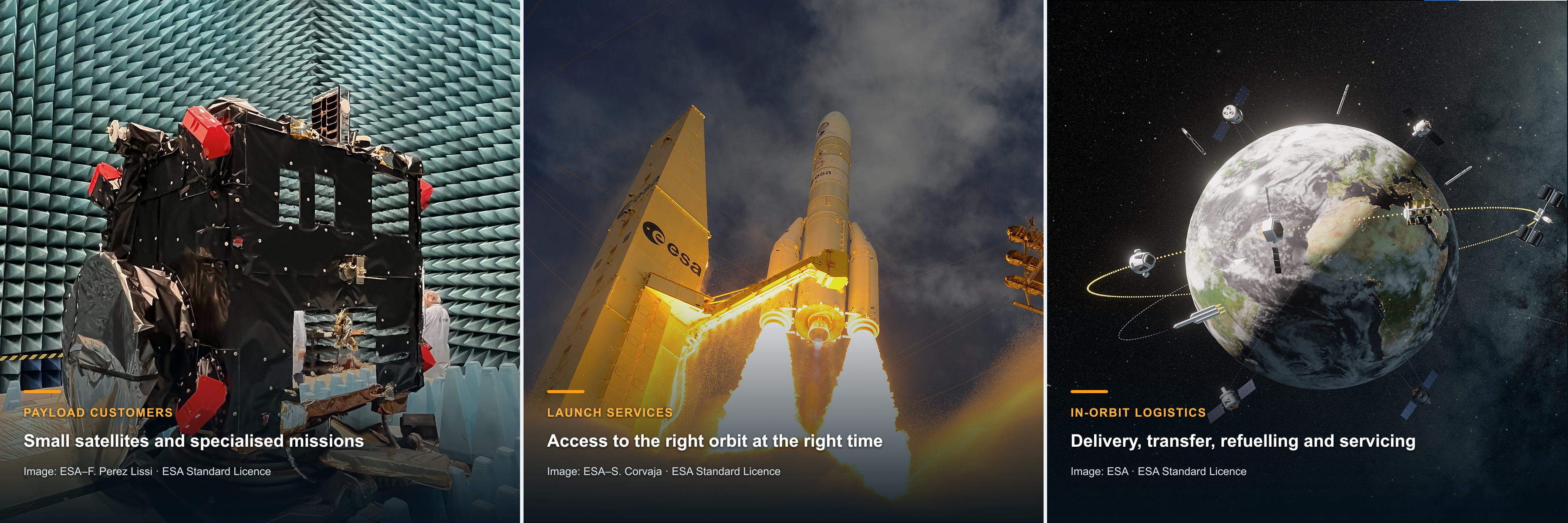
Banner image credits: ESA–F. Perez Lissi, ESA–S. Corvaja and ESA. Images adapted into a collage under the ESA Standard Licence. Sources: Hera CubeSat, Ariane 6 launch and space transportation ecosystem. No AI-generated imagery was used.

