3D-tulostus ja science fiction: Teknologian inspiroijat ja ennustajat

Science fiction on toiminut alustana, jossa 3D-tulostuksen kaltaiset teknologiat on kuvattu jo kauan ennen niiden toteutumista. Nämä tarinat ovat paitsi inspiroineet teknologista kehitystä, myös valmistaneet yleisöä uusien innovaatioiden eettisiin ja yhteiskunnallisiin vaikutuksiin. Esimerkiksi Star Trek -sarjassa esiintynyt ”replikaattori” muistuttaa hämmästyttävän paljon nykyaikaisia 3D-tulostimia. Sarjan laite kykeni tuottamaan lähes mitä tahansa materiaalia, ja se on sittemmin inspiroinut tutkijoita kehittämään teknologioita, jotka voivat valmistaa monimutkaisia esineitä kerros kerrokselta.

3D printing in science fiction

Kirjallisuus

Science fiction -kirjallisuudessa 3D-tulostus on ollut pitkään merkittävässä roolissa ennakoimassa ja inspiroimassa teknologian kehitystä. Kirjailijat kuten Hannu Rajaniemi ovat hyödyntäneet teknologian potentiaalia luodessaan maailmoja, joissa nanoteknologia ja materiaalien muokkaus ovat arkipäivää.

Rajaniemen Kvanttivaras-sarjassa materiaalien hallinta ulottuu molekyylitasolle, tarjoten lukijalle vision siitä, kuinka 3D-tulostus voisi tulevaisuudessa muuttaa sekä tuotantoa että yhteiskuntaa. Aiemmin William F. Temple esitteli idean bioprinttauksesta tarinassaan Four Sided Triangle, jossa ihminen rakennettiin molekyyli molekyyliltä. Tämä ennakoi nykypäivän keskustelua biotulostuksen mahdollisuuksista ja eettisistä kysymyksistä. Teoksesta on myös elokuva.
Neal Stephensonin The Diamond Age tutkii 3D-tulostuksen potentiaalia. Kirjassa nanoteknologia ja materiaalien ohjelmoitavuus mahdollistavat sellaisten esineiden ja tuotteiden valmistuksen, jotka mukautuvat käyttäjiensä tarpeisiin. Stephensonin visio tarjoaa näkemyksen siitä, kuinka 3D-tulostuksen ja nanoteknologian yhdistelmä voisi demokratisoida tuotantoa ja luoda uudenlaista taloudellista tasa-arvoa.

Science fiction -kirjallisuus on toiminut teknologian kehittäjien inspiraation lähteenä. Kuvaukset resursseja säästävistä tuotantomenetelmistä ja yksilöllisistä ratkaisuista heijastuvat todellisuuteen esimerkiksi muovituotteiden edullisessa piensarjavalmistuksessa. Science fiction auttaa pohtimaan teknologian vaikutuksia niin yhteiskunnallisesti kuin kulttuurisestikin.

Cory Doctorow’n Makers pureutuu 3D-tulostuksen vaikutuksiin yhteiskunnassa ja taloudessa. Doctorow käsittelee tarinassaan sitä, kuinka yksilölliset valmistusmenetelmät ja hajautetut tuotantojärjestelmät voivat muuttaa perinteisen teollisuuden ja kuluttajien roolit. Kirjassa innovatiiviset hahmot käyttävät 3D-tulostusta luodakseen uusia liiketoimintamalleja, jotka haastavat suuryritysten aseman.

Elokuvat ja televisiosarjat

Elokuvissa ja televisiosarjoissa 3D-tulostus on kuvattu monipuolisesti ja usein huikeasti tulevaisuuteen ulottuvana teknologiana. Star Trekin ”replikaattori” muistuttaa modernia 3D-tulostinta. Laite pystyi tuottamaan ruokaa, tarvikkeita ja jopa varaosia avaruusmatkailijoiden tarpeisiin, ennakoiden sekä materiaalin hallinnan että yksilöllisen valmistuksen kehittymistä. Samankaltaista ideaa jatkoi The Jetsons, jossa ”Food-a-Rac-a-Cycle” tuotti ruokaa nykyaikaisia ruokatulostimia muistuttaen.

Modernit tarinat, kuten Westworld-sarja, ovat vieneet idean pidemmälle, käyttäen kehittyneitä 3D-tulostimia ihmisten kaltaisten androidien luomiseen. Tämä käsittelee myös eettisiä ulottuvuuksia, joita liittyy kehittyvän teknologian käyttöön. Lääketieteellisessä draamassa Grey’s Anatomy esiteltiin 3D-tulostusta verisuonten valmistamiseen, mikä tuo teknologian mahdollisuudet konkreettisella tavalla katsojan arkeen.

Science fiction -tarinat toimivat paitsi ideoiden hautomona, myös väylänä valmistaa yleisöä teknologian eettisiin ja käytännön vaikutuksiin. Monia näistä sovelluksista, kuten verisuonten tulostamista tai räätälöityjä tuotteita, on jo siirretty laboratorioista käytännön sovellutuksiin, osoittaen kuinka media voi inspiroida todellisia tieteellisiä läpimurtoja.

Tarinat eivät pelkästään heijasta teknologian potentiaalia, vaan ne toimivat ideoiden hautomoina, joissa uusia teknologioita voidaan kuvitella, testata ja arvioida ennen niiden todellisuutta. Ne ovat valmistaneet yhteiskuntaa hyväksymään uusia innovaatioita ja inspiroineet tutkijoita toteuttamaan ideoita käytännössä.

On mielenkiintoista huomata, että monet science fiction -tarinoiden 3D-tulostukseen liittyvät visiot, kuten bioprinttaus ja materiaalin tehokas valmistus, ovat muuttumassa todellisuudeksi. Tämä korostaa sitä, kuinka tieteiskirjallisuus voi toimia merkittävänä ajattelun katalyyttina ja suunnannäyttäjänä tieteellisille ja teknologisille läpimurroille.

Kirjoja

  • Bear, Greg. Blood Music. Arbor House, 1985. Explores self-replicating biotechnologies, which resonate with the themes of advanced 3D bioprinting.
  • Clarke, Arthur C. Profiles of the Future: An Inquiry into the Limits of the Possible. Harper & Row, 1962. Discusses future technologies, including concepts resembling 3D manufacturing and its societal impact.
  • Doctorow, Cory. Makers. Tor Books, 2009. A novel about a near-future world where 3D printing and micro-manufacturing revolutionize industries and creativity.
  • Gibson, William. Count Zero. Arbor House, 1986.
    Features automated and decentralized production, highlighting early conceptualizations of additive manufacturing.
  • Gibson, William. The Peripheral. Berkley, 2014. Explores advanced technologies like ”fabricators,” resembling futuristic 3D printers, in a dystopian setting.
  • Lem, Stanisław. Return from the Stars. Harvest Books, 1961. Describes ”betryzing,” a form of futuristic manufacturing and replication technology similar to 3D printing.
  • Scalzi, John. The Collapsing Empire. Tor Books, 2017. Includes elements of advanced manufacturing in its depiction of a highly developed interstellar society.
  • Stephenson, Neal. The Diamond Age: Or, A Young Lady’s Illustrated Primer. Bantam Books, 1995.
    Features advanced molecular manufacturing, a speculative precursor to 3D printing technologies.
  • Temple, William F. Four Sided Triangle. Gnome Press, 1949. An early exploration of the concept of molecular duplication, akin to bioprinting, later adapted into a 1953 film.
  • Vinge, Vernor. Rainbows End. Tor Books, 2006.
    Set in a world where ubiquitous computing and advanced manufacturing, including 3D printing, have transformed society.

Tiedätkö muita tieteiskirjoja tai -elokuvia, joissa 3D-tulostus on mukana?

Pekka Ketola. 8.2.2025
3D Printing in Hospitals – Personalized Care and Better Outcomes

3D printing has numerous promising applications in healthcare, particularly in hospitals. This technology enables more personalized and efficient patient care while improving the quality of medical procedures. Let’s look at the present and the future.

Key Applications:

Anatomical Models:
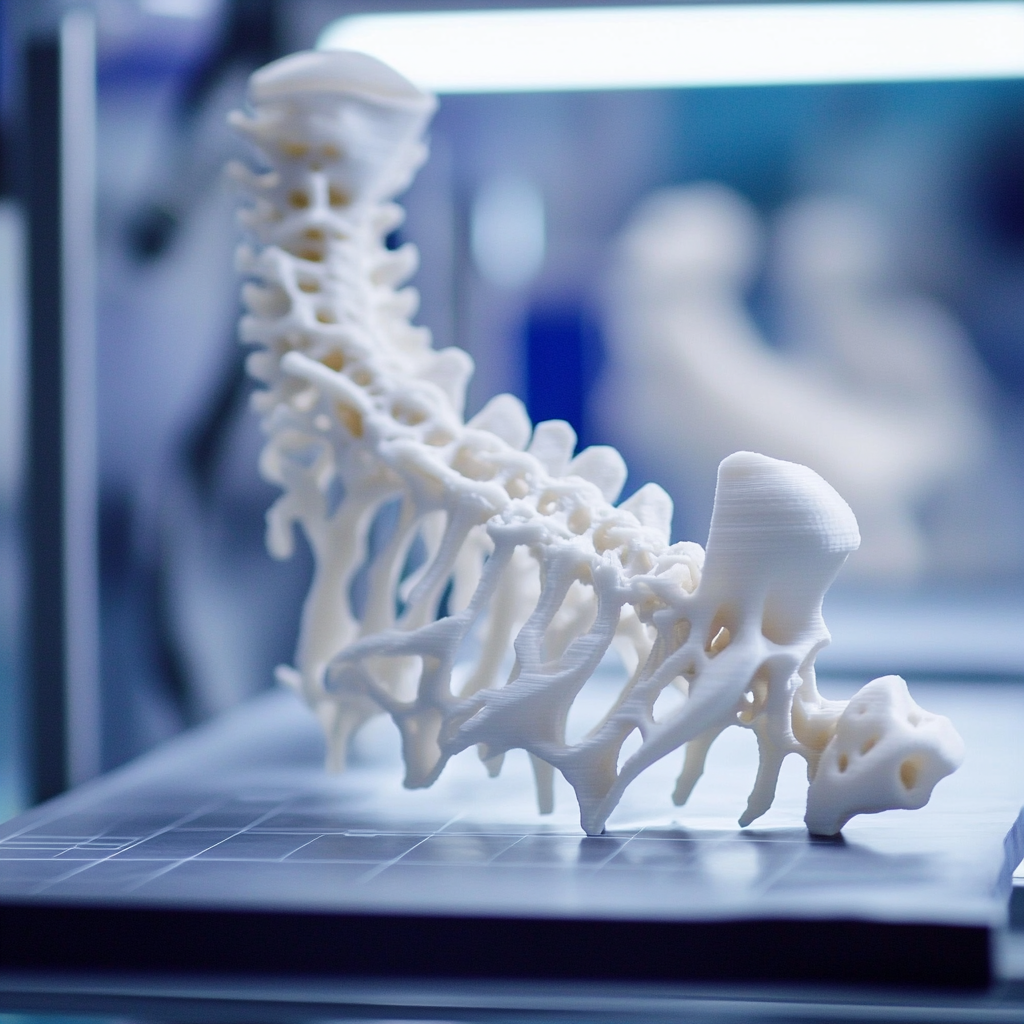
With 3D printing, patient-specific anatomical models, such as those of the heart, kidneys, or prostate, can be created based on CT or MRI scans. These models help surgeons plan complex surgeries with greater precision, enhancing patient safety. They are also valuable for medical students and patients, as they provide a clearer understanding of diseases and human anatomy.

Patient-Specific Instruments and Implants:
3D printing allows the production of custom surgical instruments and implants tailored to individual patients. This is particularly beneficial when standard-sized devices are unsuitable, such as in gynecological instruments or orthopedic implants. Personalized implants improve fit, comfort, and treatment outcomes.

Surgical Planning and Training:
3D-printed models are instrumental in planning and simulating surgeries. Surgeons can practice complex procedures on these models, reducing errors and shortening operation times. Soft models even allow surgeons to feel the structure of organs, offering a realistic training experience.

Patient Communication:
Doctors can use 3D models to explain a patient’s condition and treatment plan. These models help patients better understand their situation, reducing anxiety and fostering trust in their doctors.

Innovative Medical Devices:
3D printing accelerates the development of new medical devices and prototypes. Bioprinting—printing biological tissues—is a particularly promising field that could enable the production of new tissues and organs in the future.

Education:
Medical students and surgeons benefit from 3D-printed models for learning anatomy and practicing various surgical procedures in a realistic and hands-on way.

Future Outlook

Although 3D printing is not yet a standard practice in hospitals, its potential is immense. As the technology evolves and costs decrease, its use in healthcare is expected to become more widespread. Hospitals can invest in their own 3D printers or collaborate with specialized companies to leverage this innovative technology.

Envisioning the Future: AI, Digital Twins, and Personalized Care

The future of healthcare is set to be transformed by the convergence of 3D printing, AI, and digital twin technologies. AI-powered digital twins are expected to create virtual replicas of patients, organs, or systems. These digital twins will allow doctors to simulate a patient’s unique medical profile, predict disease progression, and tailor precision treatments.

For example, digital twins of the human brain could revolutionize the understanding and treatment of neurological diseases. Meanwhile, AI-driven tools integrated into clinical workflows will enable faster, more accurate diagnostics and treatment plans, taking into account genetic, biological, and environmental factors for truly personalized healthcare.

Advancements in genomics, gene editing, and 3D bioprinting will further enhance these capabilities. The synergy of 3D printing with AI and precision medicine could lead to entirely new approaches in patient care, such as the creation of 3D bioprinted organs customized to match a patient’s genetic makeup.

Remote monitoring and telemedicine are also expected to benefit from these advances. AI-powered wearable devices and 5G networks will allow real-time monitoring and virtual consultations, even analyzing subtle changes in speech patterns or activity levels to detect signs of illness early.

As these innovations evolve, they will work alongside 3D printing to make healthcare more efficient, precise, and accessible, paving the way for groundbreaking medical advancements and better patient outcomes.

Sources:

Functional products

What is the next generation of 3D printed products?

When the first applications of commercial 3D printing emerged, they were mostly about appearance models and prototypes. These are still, and will be, powerful and valuable applications in many businesses. During the past 10 years we have seen radical development in design tools, materials, 3D printing technologies and skills. 3D printing is now serious and reliable manufacturing method for end products, product series and spare parts in all industries. We have 3D printed products that are beautiful, optimized in many ways and serve perfectly for the intended purposes.

Is this the end of evolution? Not even close! We only start to have a good platform to imagine the future systems, after practising the technology basics and having a vague understanding of what we can make. So, here is my vision for the next generation products, made with the help of 3D printing.

“The future is already here – it’s just not evenly distributed.

– William Gibson –

Examples

  1. Interactive products will merge different technologies seamlessly, and interact with the user, system or environment in many levels. This future window is cracked open by Anouk Wipprecht. Products like Spider Dress or Proximity Dress show how products can sense and react to data or different signals from the environmnent.
  2. Personal amplifiers will give new capabilities to people. Paralympian athletes already use 3D printed prosthetes and appliances to support with a given sport, for example to run faster with spring-like artifical legs. Exosceletons are used to help lifting heavy weights. When this opportunity develops to the next level, we will build products that give us strength, better senses or capabilites never seen before. In the future we may have bionic olympics that drive the development of personal amplifiers in the same ways as Formula 1 races drive the development of better cars.
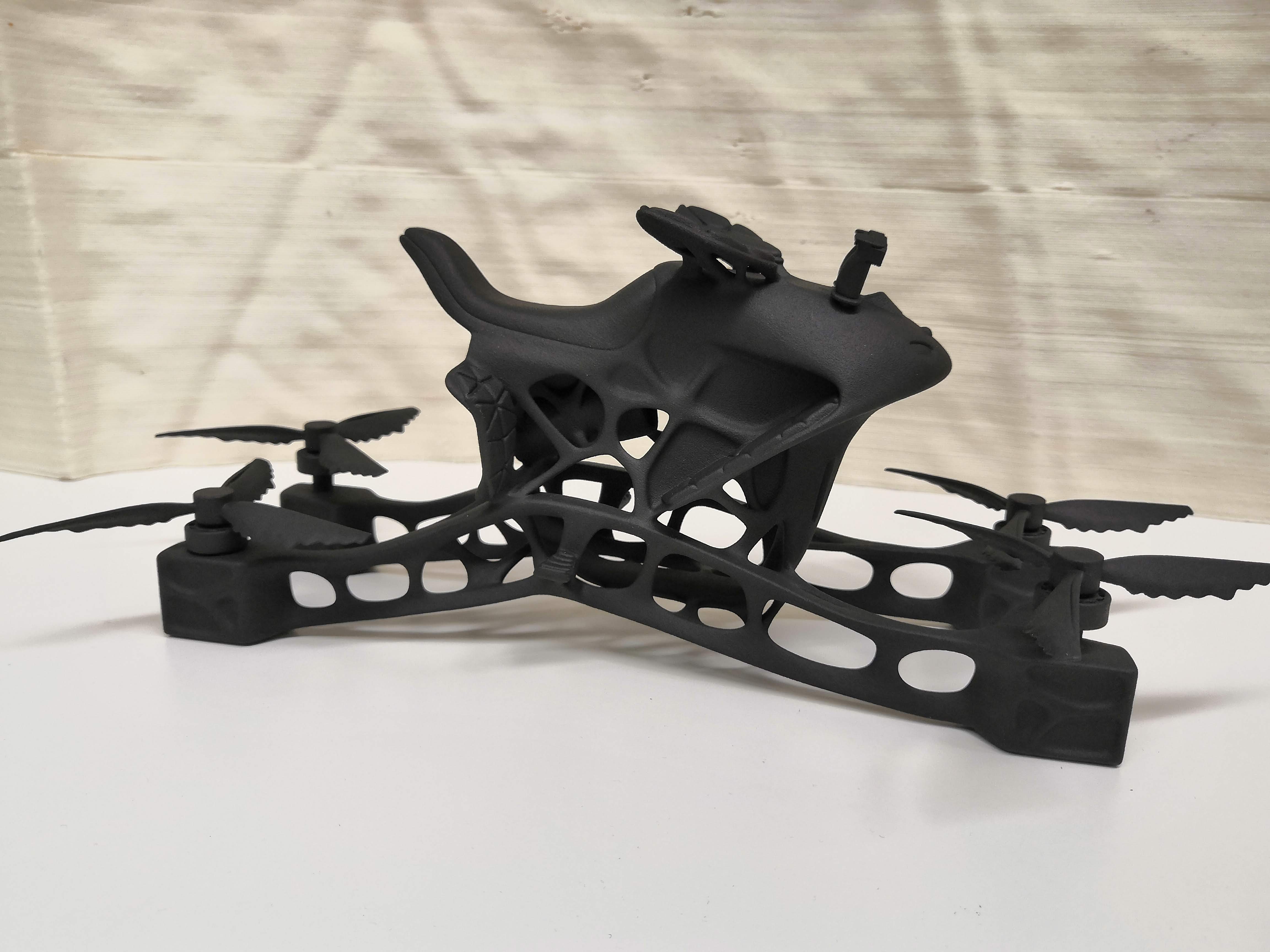
  3. New vehicles. In 1950’s the dream of a flying car emerged. Now we start to have manned drones. There are many obstacles slowing down the wider adoption, such as manufacturing cost, safety, regulation and non-existing traffic management systems for these small manned vehicles. Putting obstacles aside, let’s just ask, is it doable to make low cost flying vehicle? The concept was presented by Janne Kyttänen in his vision about 3D printed manned drone. By using suitable materials and careful optimized design, the body of the vehicle can be 3D printed in few hours with a large format 3D printer. The rest is about putting electronics, motors and other components automatically in place.
3D printed manned drone. Model 3D printed by 3DStep. Design by Janne Kyttänen.

The making of functional products

The next generation products will be based on strong systemic view. It is not about having perfect components, optimized for specific features, such as cooling or minimizing materials, but about justifying the whole reason for a product the be realised. We can make optimized components for an airplane for saving weight, or we can design new categories of sustainable flying vehicles.

The next generation products will gracefully ignore the boundaries of sciences. Rich multidisciplinary knowledge is applied to achieve the goals, such as making technology products that react with biosignals and apply artificial intelligence to perform better in a certain social context.

We will master the whole spectrum of available materials. Already today 3D printers can use an unbelievable range of materials, from living cells to tailored metal alloys. New materials emerge practically every day with amazing features. Making of the next generation functional products is not about if there is suitable materials available, but being able to define which features we want want to have in the products.

Strategic guidelines

What steps we should take towards the next generation functional products?

Collaboration is the key. Now we simply need to take collaboration into new levels. This happens by global ventures, connecting individuals, teams and developers with the help of smart development platforms. Facilitating trust between stakeholders is a mandatory activity.

Maximize creativity and imagination. Development projects are often defined by business case or ROI. The are often justified, but to maximise creativity and innovation we need more value based motivators. We, as humans, get fundamentally motivated by other things than money, especially when we face the opportunity to create radically new.

Extreme multidisciplinarity. As mentioned earlier, we need to ignore the boundaries of sciences. Products and systems of the future use the best of what humans or nature have ever invented. A powerful way to guide the development is to establish global development funds that require connecting sciences in unexpected ways. In local level great examples are, for example, hacker and maker communities, such as biocurious.org, which are based on citizen science, curiousity and co-learning.

Lets’ make it.

Pekka Ketola, February 18, 2021

CEO 3DStep Oy & Ideascout Oy. Innovator. LinkedIn

Why (the idea of) freedom of design matters?

People who don’t know too much think that with 3D printing you can create almost anything, and that there is complete freedom of design for practitioners. People who know too much tell us this is not true. Which point is more valuable?

I studied for my master’s thesis ~1990s. My major was computer science. Only at the end of the studies it became possible and economically feasible to have an own computer at home! At that time, nobody (except some visionary gurus) really believed that computers would one day be everywhere in our lives. But we had the emerging idea that something like that might happen.

In my first job as designer we were developing the first Nokia communicator with the idea that Internet would be in everybody’s pocket. Hah! We hardly had functional Internet on the planet. The idea of everybody having a mobile phone was crazy. Not to mention the possibility of having Internet in the mobile phone, available for online surfing everywhere. But we had the vision driving the development. Quite soon we sent the first ever email from a mobile phone.

Now and then we see phenoma that inspire global thinking in masses. 3D printing is such thinking platform! The sole idea of 3D printing may be more valuable than the technological reality today. It empowers millions of people to safely envision about the biggest opportunity of new level of manufacturing and products. To think about what might be possible, even when you don’t know enough about the technology. Dreaming is the most powerful innovation tool.

Thinking platforms are needed to collaboratively understand or dream of what might be possible, and then go for it. It is crucial to be able to safely and creatively produce knowledge about the possible future. It is motivating for all disciplines to set goals that seem to be impossible to reach even with sufficient resourcing. With great goals humans can achieve the impossible.

Disruptions have tendency to come unnoticed and quietly. And 3D printing is next on the line for global disruption. It generates a number of related opportunity avenues, such as materials innovation, logistics, business models and design methods.

It really doesn’t really matter if freedom of design is entirely true today. It matters that we have the inspiring possibility to think about the new design space and to develop wild ideas. Most of the dreams will realize at some point of the time.

Pekka Ketola Jan. 22nd, 2020